Rollups are Symbi-idiotic
Follow me on X if you liked this blog. Title courtesy of chainyoda
Ethereum’s pivot to rollups is often celebrated as a masterstroke: faster scaling, decentralized execution, low transaction costs. But behind the narrative, an uncomfortable truth lurks: Rollups are currently not symbiotic with Ethereum.
They are extractive layers, made possible by incentive misalignment, that weaken Ethereum’s economic engine. Meanwhile, sharding, dismissed as “too complex,” might not have been harder, and would have secured Ethereum’s monetary future far better.
It’s time to face harsh truths and confront the elephants in the room.
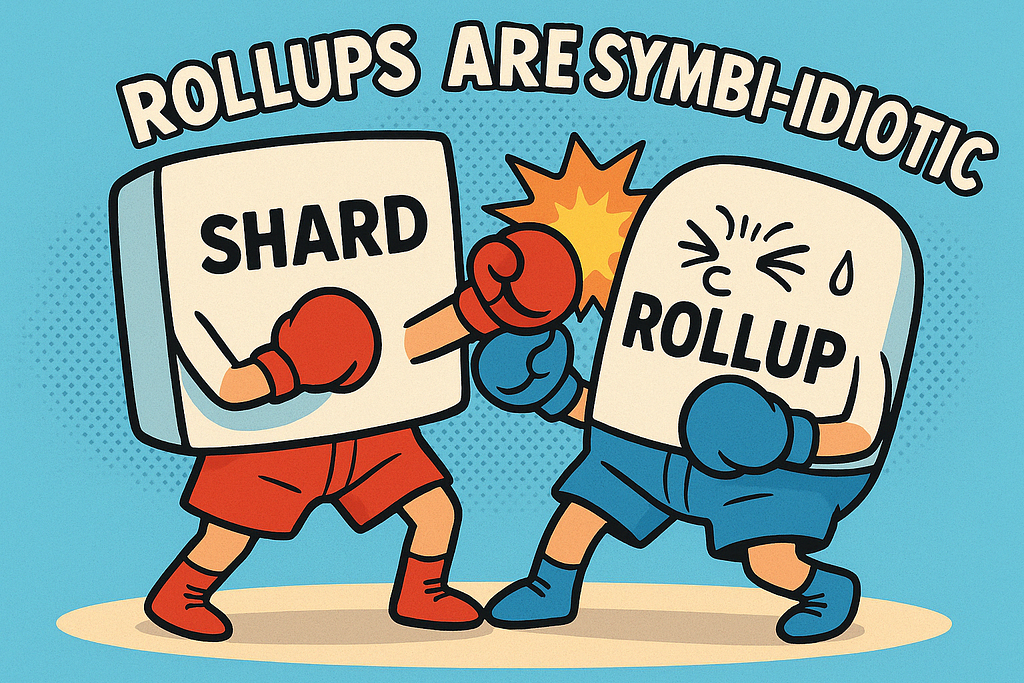
1. Rollups are extractive by design
L2 Rollups batch hundreds or thousands of transactions into a single ‘post’ on Ethereum L1 (referred to as a blob). Rollups are incentivized to maximize execution profits internally while minimizing the fees they pay to Ethereum’s base layer. The bulk of value capture (MEV, sequencer fees, …) accrues at the rollup layer, not Ethereum.
Neither are teams like Arbitrum or Optimism incentivised to decentralise sequencers or improve alignment with Ethereum, as they are raking in millions of dollars in value capture at the expense of Ethereum’s validators.
As a result Ethereum only sees a fraction of the value it enables. This is a fundamental inversion of incentives: more activity benefits rollups, not Ethereum. Ethereum’s original promise was a fully self-reinforcing ecosystem: Users pay fees → Validators secure the chain → ETH strengthens as money → Users trust the system more.
Rollups break this natural cycle. They treat Ethereum as a resource to be exploited, not an economy to be sustained. Sharding, for all its supposed complexity, would have kept Ethereum’s heart beating: one system, one economy, one money.
If we are to break the trajectory that we are on, the community must come to the realisation that Rollups are not Ethereum. They are passengers , not partners.
2. Sharding was neither impossible, nor slower
Sharding wasn’t abandoned due to technical motivations but political ones. Ethereum had already stacked significant complexity with the merge, beacon chain and maintaining compatibility with the live chain. Many of the technical drawbacks are even more exaggerated with rollups because they lack any form of standardisation imaginable. A lot of the technical complexity people blamed on "sharding" was really:
- Building a brand new consensus mechanism (PoS)
- Engineering a whole new validator flow
- Getting slashing, incentives, and liveness properties right under partial validator sets
- Migration and backward compatibility from Ethereum 1.0
Meanwhile former EF employees started their own venture funded rollup projects which destroyed all objectivity in decision making when it came to sharding vs rollups. The EF itself wanted a quick solution to not have its lunch taken by emerging alt-L1s. It was politically easier to bless rollups as the official path, even though economically rollups are parasitic if not carefully controlled and were at the time mostly technically incomplete due to a lack of fraud proofs.
“Rollups are a pragmatic solution that will get us 80% of the way to the full sharding dream, but 10 years faster.” — Vitalik Buterin, 2021.
It has already been half a decade since the “rollup-centric roadmap” was declared and trust-minimized L2s are still in transition. Most rollups still don’t have proper fraud proofs and operate on infeasible trust assumptions. Forced inclusion guarantees are still mostly theoretical. Decentralised sequencer setups are mostly experimental and there just isn’t a incentive for existing teams to switch to a based rollups, losing out on their millions of dollars in sequencer revenue.
Meanwhile the user experience on Ethereum has become completely fragmented with no final solution in sight. Account and chain abstraction remain hot topics in the Ethereum community but without a short-term solution.
It’s time that Vitalik & co admit that the rollup roadmap has all the issues that were critiques against execution sharding while just being a significantly worse end-result for Ethereum.
3. Rollups == Sharding was a lie
Many people tried arguing “each rollup is like a shard”, but that’s misrepresenting important facts. Rollups are a scaling workaround with significantly worse alignment.
+----------------------------------+----------------+---------------+
|             Property             |     Shard      |     Rollup    |
+----------------------------------+----------------+---------------+
| Revenue captured by Ethereum?    | ✅              | ❌            |
| Native trust model ?             | ✅(validators)  | ❌(sequencer) |
| Aligned with ETH value accrual ? | ✅(very strong) | ❌(very weak) |
| Decentralised by default ?       | ✅              | ❌            |
The comparison falls apart as soon as you examine incentives. Shards are part of Ethereum, secured by Ethereum validators, and naturally aligned with ETH’s economic model, congestion on a shard means higher fees, more ETH burned, and more rewards for validators. Rollups, on the other hand, are adjacent platforms that minimize what they pay to Ethereum while capturing most of the execution value for themselves. Framing rollups as equivalent to “shards” obscured the reality: this was not scaling within Ethereum’s trust model, but scaling around it , trading symbiosis for convenience.
Where do we go from here ?
Looking forward, it’s important to recognize that not all hope is lost. Ethereum is still the most decentralised and diverse blockchain ecosystem in existence with multiple client teams and lots of independent efforts. This is not to be underestimated, but by itself not sufficient.
There are efforts, like Ethereum’s exploration of native rollups and ZK-fying the base protocol, that attempt to re-tighten the alignment between scaling solutions and Ethereum’s core security and economics.
These initiatives envision a future where rollups are more tightly coupled to Ethereum’s validator set and settlement guarantees, potentially restoring the “one system, one economy” vision Ethereum once pursued.
However, it’s also worth being honest about timelines…
Based on the latest projections, full native rollup support and protocol-level ZK security are unlikely to materialize until 2029–2030. That’s nearly a full decade after the original scaling roadmap pivoted toward rollups, a longer journey than anyone expected.
In that light, it becomes fair to ask:
If Ethereum had continued pursuing execution sharding directly, gradually rolling out new shards while securing them with the Beacon Chain, would we already be enjoying native, symbiotic scaling today?
It’s plausible, even likely, that Ethereum could have introduced new shards beyond the original L1 by now, scaling capacity in a way that naturally reinforced ETH’s value and validator security without detouring through intermediary trust assumptions.
My Final Plea
Ethereum’s strength has always been its ability to evolve, sometimes imperfectly, sometimes painfully, but always aiming for better alignment between technology, incentives, and values.
Rollups are here to stay, and they will undoubtedly carry much of Ethereum’s future growth. But it’s crucial to remember the original vision: scaling should strengthen Ethereum, not hollow it out. Execution sharding wasn’t just about scaling throughput , it was about preserving the monetary and security integrity of Ethereum itself.
As native rollups and ZK-secured base layers slowly emerge, there’s still a path to rebuild that deep alignment. The lesson is clear: scaling is not just a technical challenge, it’s a political and economic one, too. Ethereum must choose symbiosis over convenience if it wants to remain the credible, neutral foundation for the next generation of the internet.
Originally published on Medium on 22 April 2025.