Jacobi Forcing
Helping AI write faster
You ask an AI a question and it starts typing. Then you wait. Most language models generate text one token at a time, so a long answer means a long chain of steps. Jacobi Forcing trains a model to work on several upcoming tokens together. On one coding benchmark, the researchers got close to four times the generation speed, though accuracy took a hit.
A token is a small piece of text: a word, part of a word, or a punctuation mark. For our example, let’s pretend each word is one token.
To write “The cat sat on the mat,” the model first predicts “The.” It uses that to predict “cat,” then uses “The cat” to predict “sat,” and so on. Each prediction depends on the words already chosen.
This is called autoregressive generation. In its ordinary form, a 1,000-token answer needs about 1,000 sequential generation steps. The model can already process your prompt in parallel, but generating the answer introduces a dependency between steps.
The chips running these models, usually GPUs, are built to do many calculations at once. If we can get several useful tokens out of each round of computation, we can spend less time waiting for the answer.
Jacobi Forcing is a training technique designed to help with this. First, we need to look at Jacobi decoding, the procedure it builds on. The decoder fills a block of upcoming tokens with guesses, updates them together, and repeats.
Think of it as revising a rough sentence. Several words might improve in one pass, while others need another go. For the model, revising means recalculating its predictions.
The detail that makes this work is that each position uses the previous round’s guesses to its left. To update the third word, the model uses the old guesses for words one and two. It doesn’t wait for their replacements. All positions can therefore update in the same model pass.
The model still only looks left when predicting a token, a property called causal attention. It can work ahead because some of those earlier tokens are allowed to be guesses.
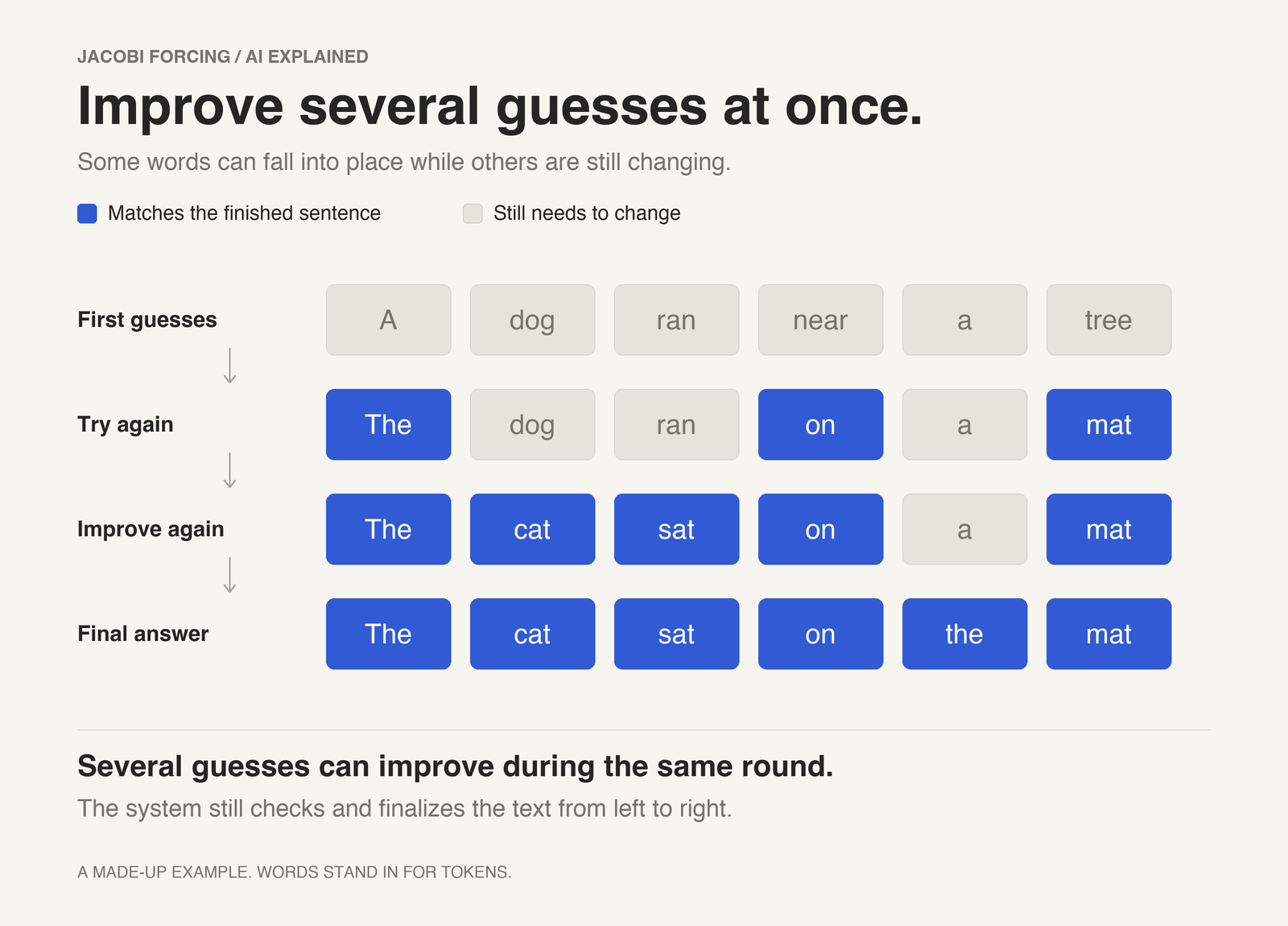
In the example, a word near the end can be right while an earlier one is still wrong. We can’t accept it yet. The decoder checks and commits an unbroken stretch from the left; anything beyond that stays provisional until the preceding text is confirmed.
There’s a catch: we need enough of those guesses to survive. A model trained mostly on clean text can struggle when its context contains mistakes. Fix an earlier token and several later predictions may need to change too. We could do all this extra work and still get just one useful new token.
Jacobi Forcing trains the model for exactly this situation. The researchers collect its decoding trajectories: the drafts it produces on the way to a settled answer. They use these to train it to reach the settled predictions with fewer rounds, even when earlier tokens or entire earlier blocks are still imperfect. They also retain an ordinary next-token training objective to help preserve answer quality.
The published recipe mixes cleaner and noisier context in a progressive schedule. Training starts with 16-token blocks for 10,000 steps. The researchers then collect fresh trajectories from the updated model and train with 32-token blocks for another 10,000 steps. Those block sizes describe the training setup; they don’t tell us how many tokens will be accepted in a generation step.
Once the guesses improve, we can get more use out of them. Multi-block decoding works ahead on later blocks while the first is being confirmed. Rejection recycling keeps useful short fragments from discarded drafts to try again later. Throwing away a draft doesn’t mean every phrase in it was bad. Both refinements still require verification before those tokens become output, as the authors illustrate here.
Keeping causal attention has a practical benefit too: the system can reuse its KV cache, stored attention information for confirmed tokens. It saves recomputing that information while the draft changes, making the approach compatible with caching already used to serve language models.
The HumanEval results show why the training matters. On this benchmark of small coding problems, the original model generated 41.3 tokens per second. Plain Jacobi decoding managed 39.9, so it was actually slower. After Jacobi Forcing training, that rose to 159.5. Multi-block decoding and rejection recycling brought it to 163.9. Most of the gain here came from training the model to make better guesses.
Here’s the broader comparison from Tables 1 and 3 of the paper. The models are based on Qwen2.5-Coder-7B-Instruct for coding and Qwen2.5-Math-7B-Instruct for maths, running on NVIDIA A100 GPUs. “7B” means roughly seven billion learned parameters. All use greedy decoding, choosing the highest-scoring next token. The Jacobi Forcing results include both refinements, with speed and quality measured under the same settings.
| Test | Tokens/s, original → JF | Speedup | Score, original → JF |
|---|---|---|---|
| HumanEval · coding | 41.3 → 163.9 | 3.97× | 87.8% → 83.5% |
| MBPP · coding | 43.1 → 113.0 | 2.62× | 74.3% → 70.4% |
| GSM8K · school maths | 41.8 → 154.9 | 3.71× | 92.4% → 91.4% |
| MATH · harder maths | 41.3 → 152.0 | 3.68× | 77.0% → 77.4% |
JF = Jacobi Forcing with multi-block decoding and rejection recycling. Coding scores measure success on the first generated answer (pass@1); maths scores are solve rates. These are researchers’ measurements, not tests run for this article.
I’d pay as much attention to the last column as the speedup. HumanEval dropped by 4.3 percentage points and MBPP by 3.9. The changes on maths were smaller. Training changes the model, and its answers can change too. Whether that tradeoff is worthwhile depends on what you’re using it for.
To put the speed in more familiar terms, 1,000 tokens at those HumanEval rates would take about 24.2 seconds versus 6.1 seconds. That’s just dividing the token count by the reported rates. It excludes prompt processing, network delays and tool calls, so it isn’t a measurement of how long you’d wait in a chat app.
The hardware and serving software matter as well. In a separate test with one request at a time on an NVIDIA B200, using the serving framework vLLM, the researchers measured 221.3 → 865.8 tokens per second, a 3.91× speedup. That’s a different setup from the A100 comparison above; the details are in Table 2.
There’s another number worth keeping straight. In the A100 HumanEval result, the decoder proposed 64-token blocks but accepted an average of 4.09 tokens per forward pass, or round of model computation. Most guesses didn’t become output in that pass. And because a parallel pass does extra work, accepting four tokens per pass doesn’t necessarily make generation four times faster.
To use this, you need a model trained for Jacobi Forcing and a compatible decoder. You can’t enable it by changing your prompt. The extra computation also means faster generation won’t automatically be cheaper or use less energy, especially on a server handling many users at once.
Also, “verification” here only checks agreement with the trained model’s own predictions. It doesn’t check facts or run the generated code. The model can still be wrong, just faster.
What I like about Jacobi Forcing is that it trains the model for the imperfect drafts it will actually see during decoding. If I were evaluating it for an application, I’d check whether the speedup holds on its real workload and what happens to answer quality.